
Clean transport
Why do we decide to buy an electric car? Each of us has slightly different reasons.
However, now, at a time when the purchase price of an electric car is higher than that of a vehicle with a combustion engine, the main motivation is very likely to be the desire to do something for the environment, for our children and their children, who will be here after us.
The desire to behave responsibly and sustainably, the very same desire that motivates us to sort our waste and try to minimise how much of it we produce.
There is a great deal of talk about sustainability, but is so much really being done to achieve it?
Do you pay attention to what you buy?
It may seem that the voices calling for high-quality, repairable goods have been heard. But what is the reality? Is it not just a marketing ploy?
For now they are more the exception, but yes, they do exist.
There are companies that care about sustainability and manufacture high-quality products with a long service life, using recycled materials, durable, and with the option of repair or modification should your needs change.
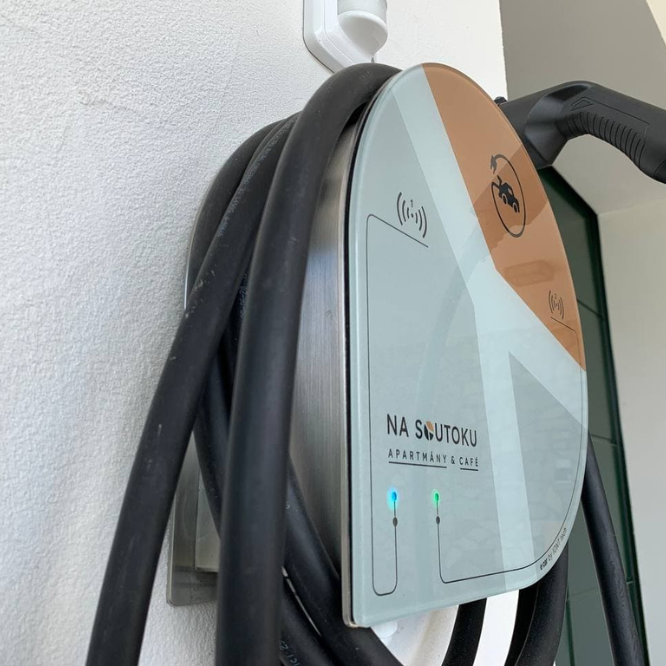
Wallboxes are no exception either - charging stations designed specifically for electric cars. Sustainability should also be taken into account when choosing one.
What should we focus on when buying if we want to support our green effort towards a more sustainable way of life?

Place of manufacture
Where the charger was made is linked to its carbon footprint.
How much fuel and energy was needed to transport the charger so that it reached your home?
Did it travel from Asia via a distributor who provided it with a Czech manual and packed it into a new colourful box, or was it made by people in the same country, on the same continent?

Material
Widely used plastics are practically doomed from the outset, at best, to be disposed of in an incinerator.
Metal, on the other hand, which has accompanied humankind for thousands of years, can be reused repeatedly at the same quality. We call this a circular material. Glass is in a similar position.
Plastic naturally does not have the same durability as metal. Almost every one of us has experienced buying a new item that was damaged from day one because the plastic part did not survive transport intact, even though we had not even started using it.
For a charging station, mechanical durability is important. It is often exposed to UV radiation, frost, and not always careful handling. When damaged, it loses its water resistance and, as an electrical device, is thus practically fit only for the bin.

Repair - modification
Our ancestors were used to repairing things so that they could be used again. Many of them still work to this day. For commercial reasons, it is more advantageous if a product cannot be repaired or upgraded. Is an irreparable product with a limited lifespan really what we want?
If sustainability matters to us, let us please also pay attention to the purchase of a home charger. Not only will you use energy from renewable sources, but your behaviour will allow future generations to use natural resources at least as much as we do.
There are also charger manufacturers who respect the philosophy of sustainability and make charging stations in the Czech Republic with maximum use of circular materials that can be repaired, supplemented and expanded depending on your needs.
We are one of them.
Čistá mobilita začíná u toho, co vydrží. Jak s udržitelností nakládáme my